

A black boneless couch can look generous and comfortable in a product photo while leaving the most useful questions unanswered. How much support is behind those cushions? How low will you sit? Can the upholstery handle your household’s cleaning routine?
A good choice starts with the construction, actual seating dimensions, and fabric instructions. Those details help you decide whether a particular model belongs in your everyday living room, an occasional-use guest room, or somewhere outside your shortlist.
Short Definition
A black boneless couch is typically a black-upholstered, frameless sofa supported mainly by foam. It offers relaxed seating, with some models providing flexible layouts and compressed delivery. Construction and features vary by product.
Topmodrenhouse Mission Statement
Topmodrenhouse helps homeowners, renters, and home lovers make informed, practical choices for living spaces that feel comfortable, personal, and stylish.
Is a Black Boneless Couch Right for Your Home?
A black boneless couch may suit your home when you want relaxed seating and a model whose support, dimensions, and care requirements match your routine. Give low, deep designs closer scrutiny when you prefer sitting upright, need supportive armrests to stand, or expect one sofa to accommodate several different sitting preferences.
Think about an ordinary evening. Watching a movie with your legs tucked underneath you places different demands on a couch than reading upright with your feet on the floor.
An occasional-use den may justify a simpler, lower-cost model. For your main sofa, prioritize comfortable sitting, documented construction, and workable returns. A lower price offers little value when the seat doesn’t suit its daily job.
The Buying Checks That Matter Most
Use these checks to narrow your options before comparing colors, accessories, or sale prices.
| Check | What to establish |
| Construction | Foam-only, foam with springs, or a conventional frame |
| Support | Backrest design, seat compression, and comfort when changing position |
| Dimensions | Usable seat width and depth, seat height, and complete footprint |
| Fabric care | Cleaning method, cover removability, and washing restrictions |
| Complete cost | Required modules, ottomans, delivery, and optional replacement covers |
| Purchase protection | Warranty coverage and return arrangements after unpacking |
Save the exact model number and configuration with your notes. Similar photographs and product names can make it surprisingly difficult to remember which specifications belong to which couch.
What “Boneless” Does—and Doesn’t—Tell You
“Boneless” commonly describes a sofa that gets its shape and support from cushioning rather than a conventional rigid frame. However, sellers use the term inconsistently. A listing may describe an all-foam design or one containing springs, so the name alone doesn’t establish what is inside.
For example, an OVIOS sectional marketed as boneless lists both foam and reinforced coil springs. That makes construction details more useful than the category label.
Other descriptions answer different questions:
- Cloud-style describes a look or perceived feel.
- Modular means the furniture consists of separate units; permitted arrangements vary.
- Compressed describes its shipping format.
- Convertible needs an explanation of how the model changes configuration.
Ask for a materials breakdown or construction diagram when the description is vague. Don’t assume a compressed sofa folds into a bed, that every module is interchangeable, or that a soft exterior means there are no hard components.
Choose Support That Matches How You Sit
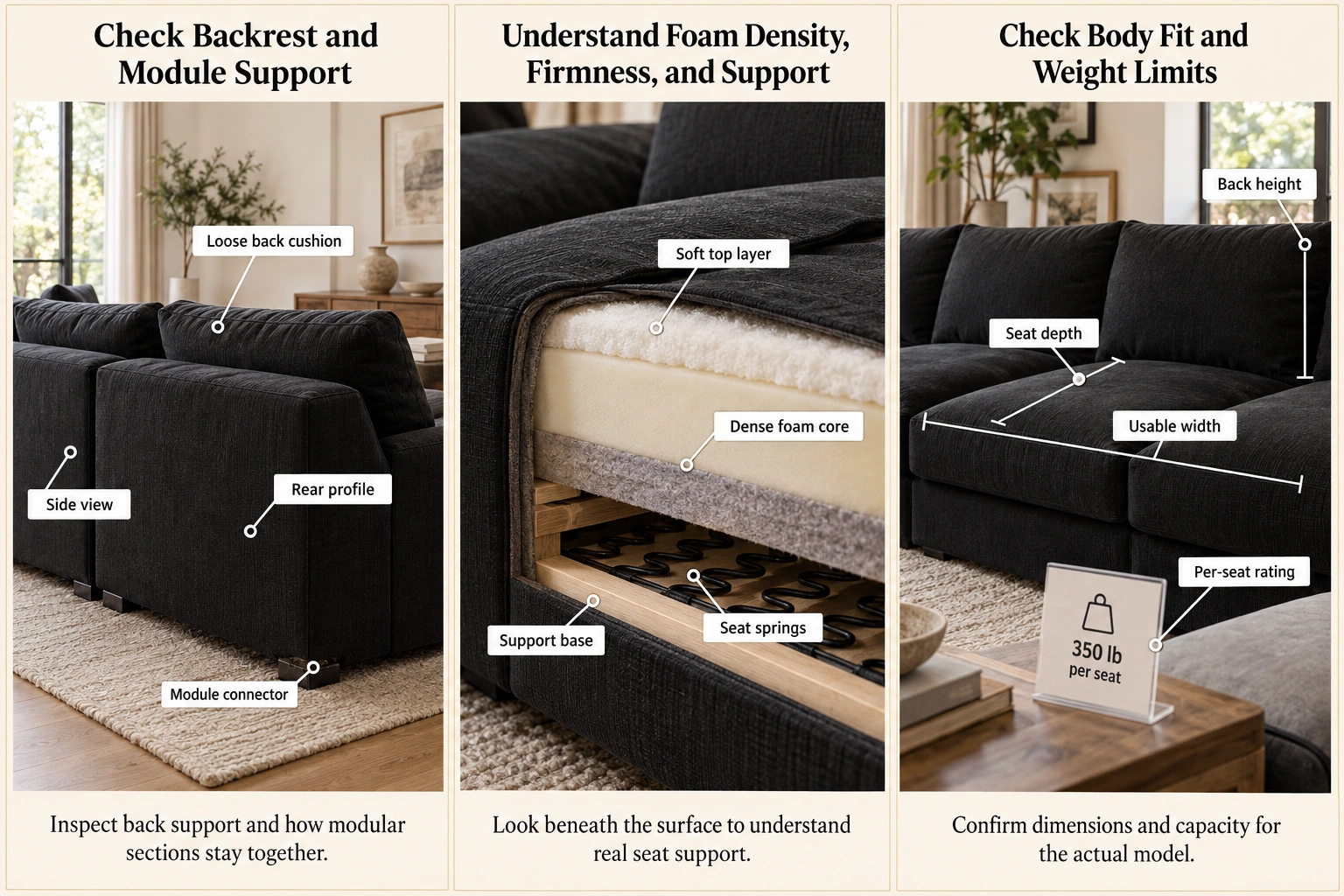
Start with the backrest. Check whether it is part of the main structure, a separate foam piece, or loose cushions. Product photographs should show the couch from the side and rear, especially when you plan to place it away from a wall.
During a showroom visit or permitted home trial, try your usual positions. Sit upright, lean back, shift sideways, and stand up. Notice whether you remain comfortably supported or keep repositioning cushions.
For modular seating, check how sections connect. Ask about clips, straps, or a non-slip base and whether the manufacturer recommends particular placement. Don’t assume every model needs wall support—or that friction alone will keep every arrangement together.
Understand Foam Density, Firmness, and Support
Foam density describes mass per unit volume, often shown in pounds per cubic foot. Firmness describes resistance to compression. They are separate properties: higher-density foam is not automatically harder. The Polyurethane Foam Association explains this distinction in its performance guidance.
For shopping purposes, ask what supports the seat beneath its softer surface. Useful information includes foam type, density where available, layer construction, and any springs.
“Premium foam” doesn’t answer those questions. Neither does a quick hand press tell you how the whole seat will feel after you settle into it.
A sitting trial helps assess initial comfort. It cannot prove how many years the couch will retain its shape.
Check Body Fit and Per-Seat Weight Limits
Boneless seating can’t be judged suitable or unsuitable for taller or heavier adults as a category. Check the particular model’s usable width, depth, back support, and stated capacity.
Confirm whether a weight rating applies per seat, per module, or to the whole configuration. Don’t divide a total figure by the advertised number of seats and assume that establishes an individual seat limit.
Height matters alongside weight. A tall person may want space to stretch out but still need a supportive backrest. Someone shorter may find that deep cushions prevent comfortable upright sitting.
Measure for Comfortable Seating and a Workable Layout
Measure a couch or chair you already enjoy using. That gives you a practical reference for comparing unfamiliar furniture online.
Record:
- Seat height: Floor to the sitting surface.
- Usable seat depth: Front edge to the back cushion in its normal position.
- Usable width: Space available between arms or bolsters.
- Back height above the seat: More useful for judging back coverage than overall height alone.
- Complete footprint: Including the chaise, ottomans, and any required spacing.
Overall depth and usable seat depth are different measurements. Thick back cushions can occupy a substantial part of a deep-looking sofa.
For example, a listing might show a broad platform in one photograph and thick cushions in another. Ask for the sitting depth with those cushions in place rather than estimating from the image.
Mark the full layout on the floor with painter’s tape suitable for your flooring. Check doors, drawers, walking routes, and access around the coffee table.
For a black boneless sectional, confirm the chaise orientation against a diagram. Establish whether “left” means left when facing the sofa and whether the configuration is genuinely reversible.
Choose Black Fabric With Everyday Care in Mind
Black upholstery deserves the same careful inspection as a lighter color. Depending on the fabric and household, contrasting lint, pale pet hair, and surface marks may be noticeable.
Request a swatch when available. View it in daylight and under your evening lighting, alongside the floor, rug, and other furniture. This helps you judge both the shade and the amount of texture you want.
Compare Corduroy, Chenille, and Velvet
Fabric names describe useful characteristics, but they don’t establish stain resistance, washability, or durability by themselves.
| Fabric | What to inspect before buying |
| Corduroy | Rib width, texture, debris removal, and approved cleaning method |
| Chenille | Surface texture, weave, seams, and documented care requirements |
| Velvet | How the pile changes appearance with touch and light, plus cleaning restrictions |
For a black corduroy boneless couch, look closely at photographs of the ribs and seams. Consider whether you’ll be comfortable maintaining that texture around snacks, pets, or frequent use.
Treat “pet-friendly” and “performance fabric” as starting points for questions. Ask what the seller means and which care instructions or test information support the claim.
Check Whether Removable Covers Are Washable
Removable covers are not necessarily machine-washable. A zipper may provide access for manufacturing or servicing rather than routine washing. Before ordering, confirm which covers come off, how each should be cleaned and dried, and whether the manufacturer provides instructions for putting them back on.
Read the upholstery label before choosing a cleaner. Care codes distinguish permitted cleaning methods; they should not be interpreted as automatic permission to machine-wash a cover.
Also ask whether replacement covers are sold separately. For a household expecting regular spills, clear care instructions and replacement availability may matter more than an extra decorative cushion.
Verify the Details Before You Order
Once a couch passes the comfort, size, and fabric checks, examine the purchase itself. Keep copies of the specifications, selected configuration, care instructions, and seller’s answers.
Compare the total cost of the layout you need. A starter price may exclude the ottoman or additional module shown in the main photograph.
Look for Model-Specific Details and Useful Owner Reviews
Useful reviews describe the exact product, how long it has been used, and what daily ownership involves.
Look for details such as:
- Whether the reviewer mainly lounges or sits upright.
- How the back cushions and modules behave during use.
- Whether the fabric has been cleaned.
- Whether the review was updated after the unboxing period.
- Photographs showing scale and the seating surface.
Check that reviews refer to your chosen size and construction. A review of another configuration or product version may not answer your question.
Owner accounts can highlight issues to investigate, but they don’t establish a failure rate. Likewise, an initial positive impression doesn’t demonstrate long-term durability.
For certification claims, verify what is covered. CertiPUR-US applies to qualifying foam, not automatically to an entire sofa
Check Package Sizes, Weights, and Expansion Instructions
Boxed delivery can help with access, but you still need each package’s dimensions and weight. Check stairs, landings, elevators, and tight turns rather than measuring only the front door.
Plan where unpacking will happen and follow the supplied instructions. Keep packaging away from children and pets, and use care when opening wrapping close to upholstery.
Expansion time varies. One reviewed seller specifies five to seven days for certain compressed models, so a universal 24–72-hour promise would be misleading. Follow the instructions for the exact couch you buy.
Photograph the condition on arrival. Contact the seller about damage, missing pieces, or incomplete expansion within its stated reporting period. Avoid improvised heat or steam treatments unless expressly approved.
Confirm Warranty Coverage and Returns After Unpacking
A return window is only part of the policy. Before purchasing, ask:
- Can the couch be returned after opening and expansion?
- Must it fit inside the original packaging?
- Who arranges collection or freight shipping?
- What shipping, collection, or restocking charges apply?
- Are made-to-order items or particular configurations excluded?
Read the warranty separately. Check whether it covers foam deformation, seams, zippers, and connectors—and how it distinguishes a defect from normal softening or wear.
On marketplaces such as Amazon or Wayfair, inspect the terms attached to the particular listing and seller. Keep written answers when a policy does not clearly address compressed furniture.
Frequently Asked Questions
How Long Does a Boneless Couch Last?
There is no reliable lifespan that applies to every boneless couch. Construction, materials, frequency of use, and care all affect the outcome. Assess documented specifications, longer-term reviews of the exact model, replacement options, and warranty exclusions rather than relying on an unsupported promise of a certain number of years.
Can a Boneless Couch Replace a Regular Bed?
A boneless couch should not be assumed suitable as a regular bed simply because its sections form a flat surface. Check whether the manufacturer intends it for sleeping, the usable sleeping dimensions, gaps between modules, and care requirements. Occasional guest use and nightly sleeping are different purchase decisions.
Can You Compress a Boneless Couch Again for Moving?
Don’t assume you can return an expanded couch to its original shipping size. Ask the manufacturer whether recompression is supported and how the product should be moved. Unless it provides an approved method, plan around the expanded modules’ dimensions and weights, including the route out of your home.
Make Your Final Choice With Support, Size, and Fabric in Mind
Choose the couch whose verified details suit how you sit, the space you have, and the care you’re prepared to give it. Confirm the complete cost and what happens if it arrives unsuitable.
Missing information is a reason to ask another question before ordering. Clear specifications and workable purchase terms help you make a decision that goes beyond an appealing photograph.
Disclaimer
This content is for general informational purposes only. Homes, needs, preferences, budgets, and circumstances vary. Verify product details and follow manufacturer instructions. Seek qualified professional advice for safety, installation, repair, legal, structural, electrical, plumbing, HVAC, or major property decisions.