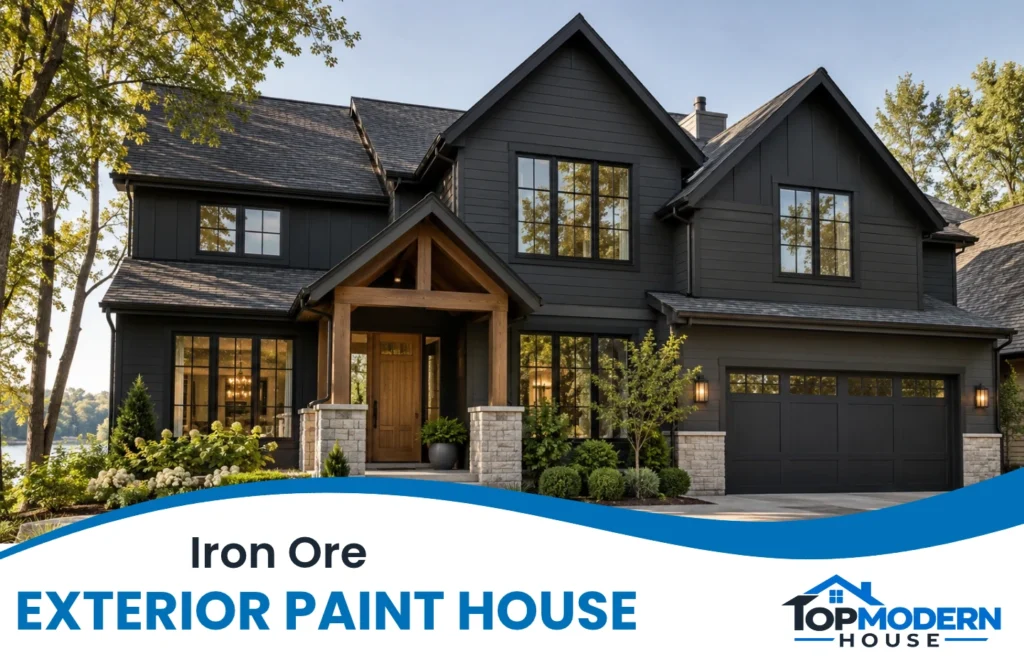
Iron Ore can look like a soft charcoal on one house and almost black on another. The difference often lies in the light, surrounding materials, and how much of the exterior carries the color.
Choosing Iron Ore exterior house paint means judging the whole facade—not just liking a swatch. Your roof, windows, brick, and shaded areas will help determine whether the finished result feels balanced or darker than you intended.
Short Definition
Iron Ore exterior house paint refers to Sherwin-Williams SW 7069, a deep charcoal used on exterior surfaces. Homeowners consider it for dark siding or contrasting accents on doors, shutters, and trim.
Topmodrenhouse Mission Statement
Topmodrenhouse helps homeowners, renters, and home lovers make informed choices for practical, comfortable, and stylish living spaces.
Is Iron Ore the Right Kind of Dark for Your House?
Iron Ore is worth considering when you want a distinctly dark exterior and like its appearance beside the features you’re keeping. It may feel too dark when your goal is a clearly gray house, especially across shaded walls. The decision depends on your preferred contrast and actual sample results.
Start with the result you want. Would you be comfortable with the siding looking nearly black for part of the day? Do you want architectural details to stand out, or would you prefer a quieter, more uniform exterior?
Those questions are more useful than deciding whether Iron Ore is universally a “good” exterior color.
What Exterior Examples Reveal About Iron Ore
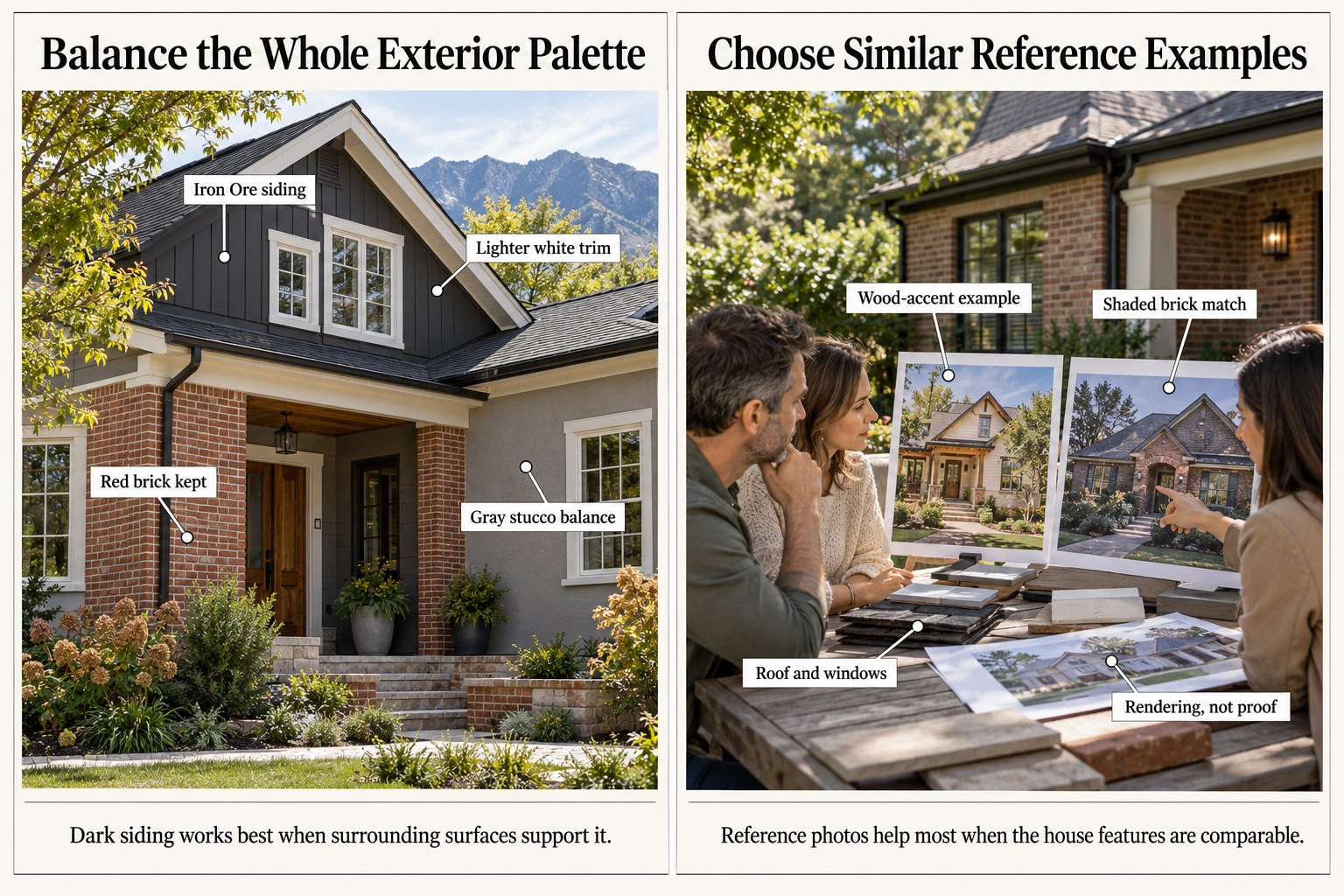
A documented Colorado project by The Color Concierge shows how changing the surrounding palette can improve a dark exterior. The designer used Iron Ore siding alongside retained red brick, lighter Egret White trim, and mid-tone Intellectual Gray stucco. The lighter trim also helped connect existing white windows to the darker siding.
The useful lesson is that the balance came from several surfaces working together. Copying only the siding color would miss much of what made that scheme successful.
For another approach, brick&batten’s Iron Ore review includes a California bungalow design with wood accents. Its exterior design illustrations help show possible color placement, but a rendering isn’t evidence of exactly how paint will appear on your property.
Choose reference images with features similar to yours: comparable roof color, window frames, masonry, and porch depth. A sunlit contemporary facade offers limited guidance for a heavily shaded brick house.
How Light and Undertones Change Iron Ore’s Appearance
Sherwin-Williams Iron Ore SW 7069 is a deep charcoal commonly described as a soft black. Its light reflectance value, or LRV, is approximately 6; Sherwin-Williams’ detailed color data lists 5.55. LRV describes visible-light reflectance, placing Iron Ore firmly among very dark colors.
That number helps establish its depth, but it doesn’t tell you whether you’ll like the color beside your roof or stone. It also doesn’t specify the paint’s sheen.
Direct Sun, Shade, and Covered Porches
Bright outdoor light can reveal more of Iron Ore’s charcoal character. Shaded areas may appear closer to black. Exterior color consultants document these differences, while also noting that Iron Ore remains a dark choice even outdoors.
Consider the parts of your house you see most often. A sample on an exposed garage wall might look appealing at midday while giving little indication of the effect around a recessed front door.
Don’t choose it on the assumption that sunlight will turn it into a medium gray.
Could Iron Ore Look Green or Blue on Your Exterior?
Iron Ore can show a subtle green cast in some settings, while other published observations describe a blue-leaning appearance. These descriptions aren’t guarantees for your house. Lighting, nearby finishes, and the way a photograph is captured can complicate what you see, so judge a physical sample in its intended setting.
When checking the sample, ask whether you like its relationship with the surrounding materials. You don’t need to agree on the perfect undertone label to recognize an unwanted color combination.
Coordinate Iron Ore With Your Roof, Masonry, and Trim
The strongest starting point is the exterior you already have. Identify the roof, masonry, window frames, and other finishes that will stay. Then consider which painted surfaces should connect those elements and which should stand apart.
Start With the Roof, Brick, Stone, and Mortar
Place your sample where you can see it alongside the roof and masonry—not against an isolated wall.
Look beyond the broad description “red brick” or “gray stone.” Notice the mortar, darker flecks, and any tan, pink, or golden areas. Decide whether Iron Ore creates the contrast you want or makes one element feel disconnected.
A dark roof and dark siding may suit a restrained palette. They may also provide less separation than you expected. Neither outcome is automatically wrong; the question is whether it matches your intention.
There’s no need to paint retained brick simply because the first siding sample doesn’t work.
Choose Trim Around Existing Window Frames and Wood Accents
Window frames and the trim surrounding them are separate decisions. For example, a house with fixed white frames may need a different trim approach from one with black frames.
Pure White, Alabaster, and Egret White are candidates to compare, rather than interchangeable answers. Published Iron Ore schemes and reviews use these colors in different contexts.
An Iron Ore exterior with white trim can provide pronounced contrast. Check whether you want that emphasis around every window and roof edge.
Include wood in the same evaluation. Compare the intended cedar stain or wood finish beside the paint, preferably on a representative piece of the actual wood. Don’t select both separately from unrelated inspiration photos.
Choose Between Full Siding and Smaller Iron Ore Accents
Use Iron Ore across the siding when you want a dark house and approve its appearance over the main elevations. Choose smaller applications when you want dark definition while retaining a lighter exterior. Doors, shutters, and selected trim can form a complete design rather than a compromise.
| Application | What to consider |
| Whole-house siding | Whether broad dark coverage suits the roof, windows, and shaded areas |
| One section of the facade | Whether the color change follows a clear architectural boundary |
| Front door | Whether the door should blend into the entrance or stand out |
| Garage door | Whether you want the garage to attract attention or recede |
| Shutters and trim | Which details deserve emphasis and which would become visually busy |
Look at fascia, soffits, gutters, and downspouts individually. Painting everything described as “trim” the same color may not produce the effect you want.
Which Colors Should You Compare With Iron Ore?
Compare Iron Ore with alternatives that answer a specific concern: too dark, not dark enough, too charcoal, or the wrong relationship with surrounding materials. A small, purposeful shortlist is easier to evaluate than a wall of unrelated samples. Compare the colors together under the same conditions.
| Color | Reason to sample it |
| Sherwin-Williams Peppercorn | You want to explore a lighter dark-gray direction |
| Sherwin-Williams Tricorn Black | You want a stronger black appearance |
| Sherwin-Williams Urbane Bronze | You want to compare a browner, earthier direction |
| Benjamin Moore Wrought Iron 2124-10 | You want another soft-black option rather than an assumed equivalent |
These are recurring comparison choices in color-consultant reviews. Their usefulness lies in seeing the differences on your property, not finding a universal winner.
For Wrought Iron versus Iron Ore, check current specifications rather than copied comparison charts. Benjamin Moore’s current US page lists Wrought Iron’s LRV as 8.17. Similar names and dark appearances don’t make the colors identical.
Test Iron Ore Where It Will Actually Be Used
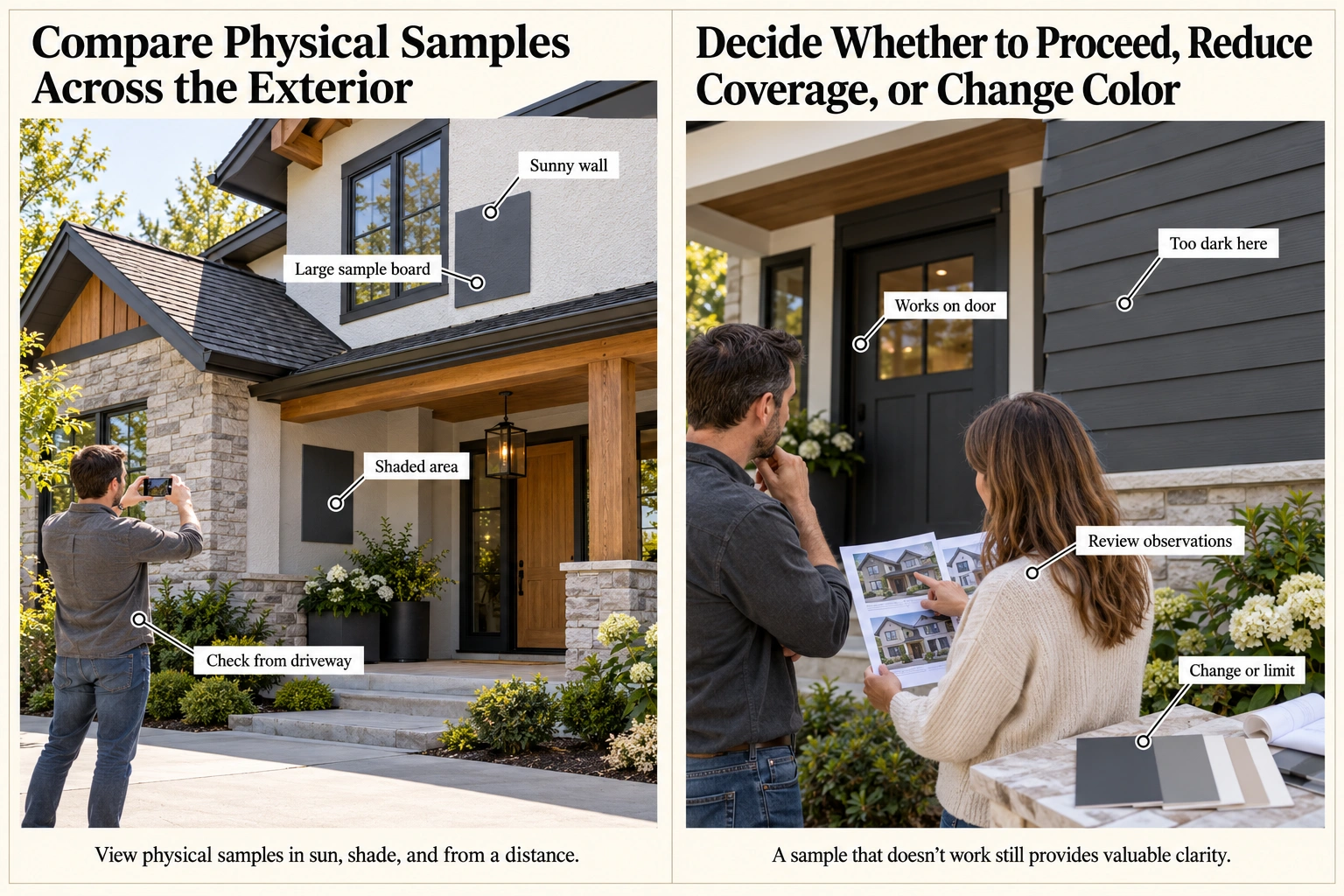
A useful sample test should help you make a decision, not merely confirm that you like the color in one convenient spot.
Compare Physical Samples Across the Exterior
- Use a sufficiently large physical sample. Make it easy to assess beyond arm’s length. Follow the sample product’s application instructions.
- Check representative locations. Include an exposed wall, a shaded area, and the entrance if those surfaces are part of the project.
- Bring companion colors together. Evaluate proposed trim and wood finishes alongside the roof, masonry, and window frames.
- Observe different conditions. Revisit in morning, midday, and later daylight, including overcast conditions when possible.
- Step back. View the combination from the sidewalk or driveway, where the entire facade matters.
- Confirm the intended finish. Before full application, ask your painter or paint supplier how to verify the selected product and sheen on a suitable test area.
Use photographs to record observations, but return to the physical samples for approval. Benjamin Moore likewise cautions that screen and printed representations can differ from actual paint colors.
Decide Whether to Proceed, Reduce Coverage, or Change Color
Proceed when you like the sample across representative locations and it works with the features you’re retaining.
Reduce coverage when you like Iron Ore on a door or smaller element but dislike its effect across a large wall.
Reconsider when it consistently appears too black, produces an unwanted cast, or seems acceptable only when you imagine replacing expensive surrounding materials.
A sample that rules out the color has done its job.
Confirm the Surface, Paint Product, and Finish Before Painting
Iron Ore is a color selection, not a complete coating specification. Wood, fiber cement, stucco, masonry, and metal need products and preparation appropriate to their condition and use.
Vinyl requires a specific compatibility check. Sherwin-Williams offers approved VinylSafe colors and formulations, including selected darker options. Don’t assume ordinary Iron Ore tinting is suitable for your vinyl siding; confirm the exact formulation and the siding manufacturer’s requirements before proceeding.
Ask for the product line, color, sheen, preparation, and any primer requirements to be recorded in the painting proposal. There’s no single finish or coat count that can responsibly be prescribed for every exterior.
Discuss damaged surfaces or moisture concerns before painting. For preparation that could disturb older paint on a pre-1978 home, EPA recommends a lead-safe certified contractor.
Frequently Asked Questions
Can Iron Ore Work on a Small House?
Yes, a small house can be a reasonable candidate for Iron Ore. Size alone doesn’t settle the choice. Evaluate the amount of dark-painted surface, the window and roof relationships, and whether important details remain visible. Judge the whole facade from the street rather than relying on a close-up sample.
Can Another Paint Brand Match Iron Ore Exactly?
Don’t assume a cross-brand match will be indistinguishable. Color-consultant guidance cautions that matching can introduce differences in depth and undertone. When considering another manufacturer, approve a sample of the actual proposed product and finish rather than relying solely on the original Sherwin-Williams chip.
Will Iron Ore Fade in Direct Sunlight?
The color name alone cannot establish a reliable fading timetable. Check the selected exterior coating’s guidance and warranty, and ask about its suitability for your exposure and surface. Avoid accepting promises that Iron Ore will remain unchanged—or require repainting after a fixed period—without product-specific evidence.
Make the Final Choice From Your House and Your Samples
Iron Ore exterior house paint deserves a place on your shortlist when you want a genuinely dark facade. Choose it because you like the tested combination of siding, roof, masonry, and trim—not because another house photographed well.
Disclaimer
This content is for general informational purposes only. Homes, needs, preferences, budgets, and circumstances vary. Follow applicable manufacturer instructions and seek qualified advice for safety, installation, repairs, legal matters, structural work, electrical, plumbing, HVAC, or major property decisions.