
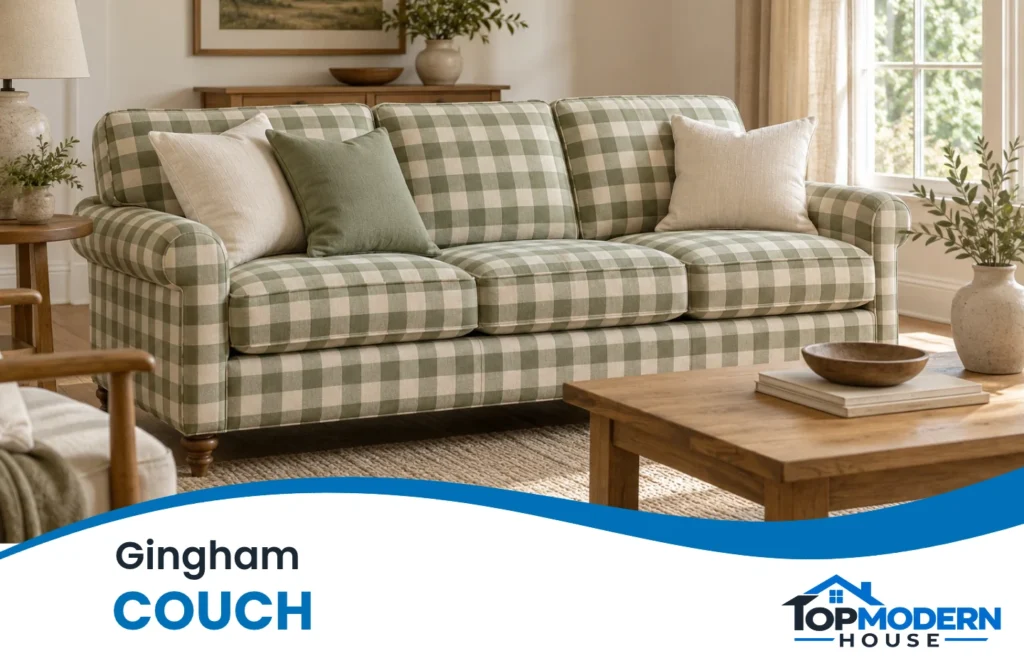
A gingham couch brings a repeating pattern into the largest upholstered piece in the room, so the choice affects more than the seating. Color, check size, and surrounding furnishings all influence how it looks.
Start with your room’s existing colors, then consider fabric care, dimensions, and comfort. Once those choices work together, styling becomes easier—and you can decide whether new seating, a fitted cover, or reupholstery makes the most sense.
Short Definition
A gingham couch is a sofa upholstered or covered in a regular checked pattern, typically combining a light background with a contrasting color. It adds pattern and character to a living room.
Topmodrenhouse Mission Statement
Topmodrenhouse helps homeowners, renters, and home lovers make informed choices for practical, stylish, and comfortable living spaces.
What Makes a Couch Gingham?
A gingham sofa has a regular checked pattern, typically combining white or another light background with a contrasting color. The intersecting bands create lighter and darker squares. In furniture listings, “gingham” may describe the pattern’s appearance rather than identify one particular fiber or fabric construction.
That distinction matters when shopping. A gingham-patterned upholstery fabric and lightweight gingham intended for other uses aren’t automatically interchangeable.
Plaid is a broader description that often includes intersecting bands of different widths and colors. Buffalo check commonly refers to larger, bold checks, although retailer terminology overlaps. Look closely at photographs and swatches rather than relying entirely on the product name.
Also check what’s actually patterned. A solid sofa with gingham pillows offers a different look from fully checked upholstery.
Choosing a Gingham Couch for Your Room and Household
The right choice should work with both the room and the people using it. Decide how much visual attention you want the sofa to attract, how you usually sit, and what maintenance you’re prepared to handle.
Choosing Colors and Check Sizes
Start with furnishings you expect to keep: flooring, wall color, the main rug, curtains, and nearby chairs. The sofa doesn’t need to match them exactly, but its colors should feel intentional alongside them.
These illustrative combinations offer starting points:
- Blue checks: Cream curtains, warm wood, and a textured neutral rug can create a relaxed arrangement.
- Green checks: Off-white upholstery accents and wood furniture can support an earthy palette.
- Red checks: Tan, cream, or restrained blue accents can balance a stronger color.
- Yellow checks: Warm neutrals can keep the room coordinated without repeating yellow everywhere.
- Black-and-white or neutral checks: Simple furniture shapes can give the pattern a contemporary setting.
Check size and contrast work together. Small checks can still look busy when the colors contrast sharply; larger checks can feel quieter when the shades are close.
Request a fabric swatch and view it beside your rug and curtains in daylight and under evening lighting. Examine it close up, then step back. A small sample may not show enough of a large repeat, so ask for a larger sample or a photograph of the fabric covering the complete sofa.
Selecting Fabric for Everyday Use
The pattern tells you how the upholstery looks. The specifications and care instructions tell you more about whether it suits your household.
Check the fiber composition, intended upholstery use, cleaning method, and any documented performance claims. A cotton blend or linen blend shouldn’t be judged solely by its name; construction, backing, and finishes also deserve attention.
For a household with children, consider how spills would be handled and whether replacement covers are available. With pets, examine the texture, ask about snagging concerns, and compare the fabric against visible fur. A “pet-friendly” label doesn’t explain every limitation.
Performance upholstery also needs scrutiny. Ask what the stated performance covers and which cleaning methods are permitted.
Abrasion ratings can provide useful context, but higher numbers don’t translate directly into a longer lifespan. The Association for Contract Textiles cautions against using abrasion-test results as a reliable prediction of fabric life.
Finally, examine close-up photographs of the checks around seams and cushions. Ask about conspicuous alignment changes before ordering custom upholstery.
Checking Size and Seating Comfort
Measure the sofa’s proposed footprint, including its depth. Painter’s tape can help show whether the placement leaves comfortable movement around tables, doors, and nearby furniture.
Overall width doesn’t tell you how much seating is usable: wide arms occupy part of that measurement. Overall depth also differs from seat depth, which describes the space available for sitting.
Test the seating in ways that reflect your habits:
- Sit upright with your feet supported.
- Lean back and assess the back cushions.
- Try your usual lounging position.
- Notice whether getting up feels comfortable.
A gingham loveseat may suit an apartment, but compact dimensions don’t automatically mean adequate seating.
Measure the delivery route as well as the room. Door openings, hallways, stairs, elevators, and tight turns can affect access. Confirm the retailer’s measuring requirements and whether removable legs or other components change delivery dimensions.
New Couch, Gingham Cover, or Reupholstery?
Choose the route according to the condition and comfort of your existing seating. A cover can change its appearance, while reupholstery offers a more involved update. Neither should be assumed to solve internal problems without assessing them.
| Option | When it may make sense | What to check |
| New sofa | Your current seating doesn’t meet your space or comfort needs | Dimensions, construction, fabric, delivery, and returns |
| Fitted slipcover | You like the existing couch and a compatible cover is available | Exact model, cushion layout, coverage, and care |
| Loose cover | You want a flexible change and accept a draped appearance | Measurements, exposed areas, and repositioning needs |
| Reupholstery | You want to retain suitable furniture and choose its covering | Frame condition, scope of work, fabric suitability, and a written quote |
A gingham couch cover listing may sell only a seat protector, cushion cover, or sample. Check the selected variation carefully.
For fitted replacements, match the model and configuration rather than just the width. A cover designed for separate cushions may not suit an attached-cushion sofa.
Reupholstery deserves an individual assessment. Ask an upholsterer whether the furniture needs repairs or new cushioning and how pattern matching affects the work.
How to Style a Gingham Couch in Your Living Room
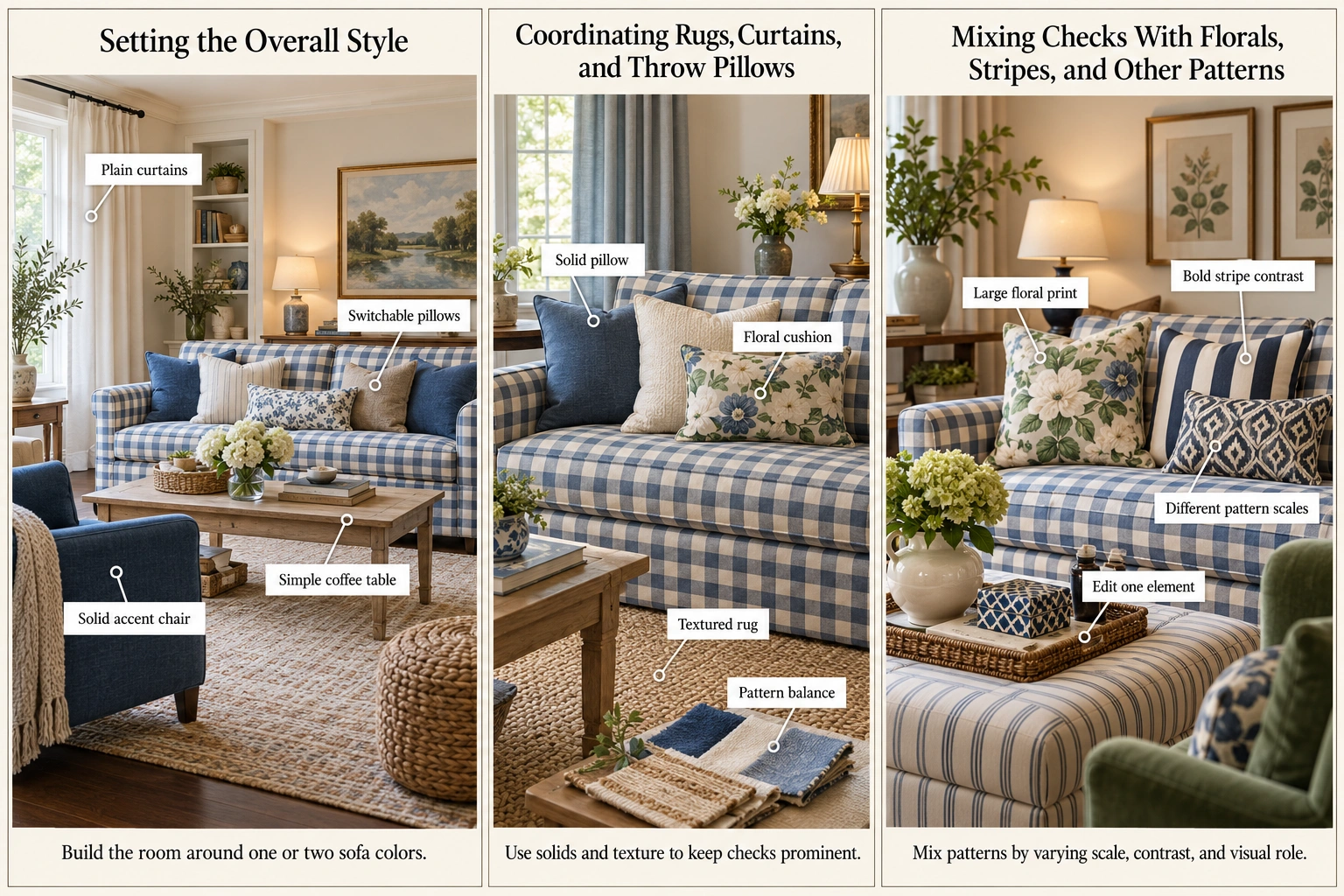
Style a checked sofa by connecting one or two of its colors with surrounding furnishings, then balancing the checks with solids, textures, or complementary patterns. Decide how prominent you want it to feel. The room can be restrained or layered; successful coordination depends on the complete arrangement.
For an illustrative modern room, consider neutral checks with a simple coffee table, plain curtains, and a solid-color accent chair. For a cottage-style room, blue checks could sit alongside wood furniture, floral pillows, and softer lighting.
The silhouette contributes to the effect. Track arms and exposed legs offer a different impression from roll arms and a skirted base. Choose the combination that suits your taste rather than assuming gingham belongs to one decorating style.
Keeping an existing couch? Begin with movable accessories. Changing pillows, repositioning a rug, or simplifying competing patterns can help you evaluate the room before buying additional furniture.
Coordinating Rugs, Curtains, and Throw Pillows
A textured or solid-color rug is a useful starting point when you want the sofa’s checks to remain prominent. Bring home a sample where possible and compare it directly with the upholstery.
A patterned rug can also work. Consider its colors, scale, and contrast alongside the sofa rather than trying to match the designs exactly.
Curtains influence the room’s overall pattern balance because they cover a substantial area. Plain curtains leave more room for patterned pillows; printed curtains may call for simpler accessories elsewhere.
Choose pillows that provide a connection or a deliberate change. A solid pillow can repeat the darker check color, while a floral cushion might share only one shade. Different textures can add interest without adding another print.
There’s no required pillow count. Leave enough space for the sofa to function comfortably.
Mixing Checks With Florals, Stripes, and Other Patterns
Gingham can sit alongside florals, stripes, and geometric designs. Designer examples show checked seating combined with floral pillows and other patterned furnishings, rather than isolated from every competing print.
Try giving each pattern a different visual role. For example, small blue checks could accompany a larger floral cushion that contains blue and cream. A broad stripe might provide a clearer contrast than another grid of a similar size.
Lay samples together and assess them from across the room. When the arrangement feels crowded, simplify one element at a time. Changing the curtains or removing one patterned cushion may be enough; you don’t need to replace everything.
Where to Look and What to Check Before Buying
Look through retailers with upholstery selectors, specialist furniture makers, replacement-cover sellers, and vintage marketplaces. Broaden searches to include “gingham sofa,” “checked upholstery,” your preferred color, and the furniture configuration.
Search results aren’t proof of an exact match. Some categories include unrelated patterns, solid seating, and accessories.
Before ordering, confirm:
- Selected fabric: The color and pattern shown correspond to the option in your order.
- Item included: The listing sells a complete sofa, full cover, individual component, or sample.
- Measurements: You have overall and seating dimensions, plus delivery information.
- Full cost: The quote includes applicable delivery, taxes, fabric upgrades, or additional work.
- Timing and terms: Lead times, cancellation conditions, returns, and damage-reporting procedures are clear.
- Future upkeep: Care instructions and replacement-cover availability are documented.
Custom and made-to-order purchases deserve particular attention to written terms. Keep the fabric name, order details, and seller correspondence.
Inspecting a Vintage or Secondhand Couch
Ask for clear photographs of the seat deck, cushion undersides, seams, legs, and visible frame areas. Discuss odors, stains, previous repairs, and any known storage history.
Inspect in person when practical. Sit in several positions and check for uneven support, movement, or loose components. Attractive upholstery can distract from condition issues.
A vintage gingham couch may be worth retaining, but appearance alone can’t establish structural condition. Seek an upholsterer’s assessment when internal repairs or substantial reupholstery are part of the plan.
Caring for Gingham Upholstery and Covers
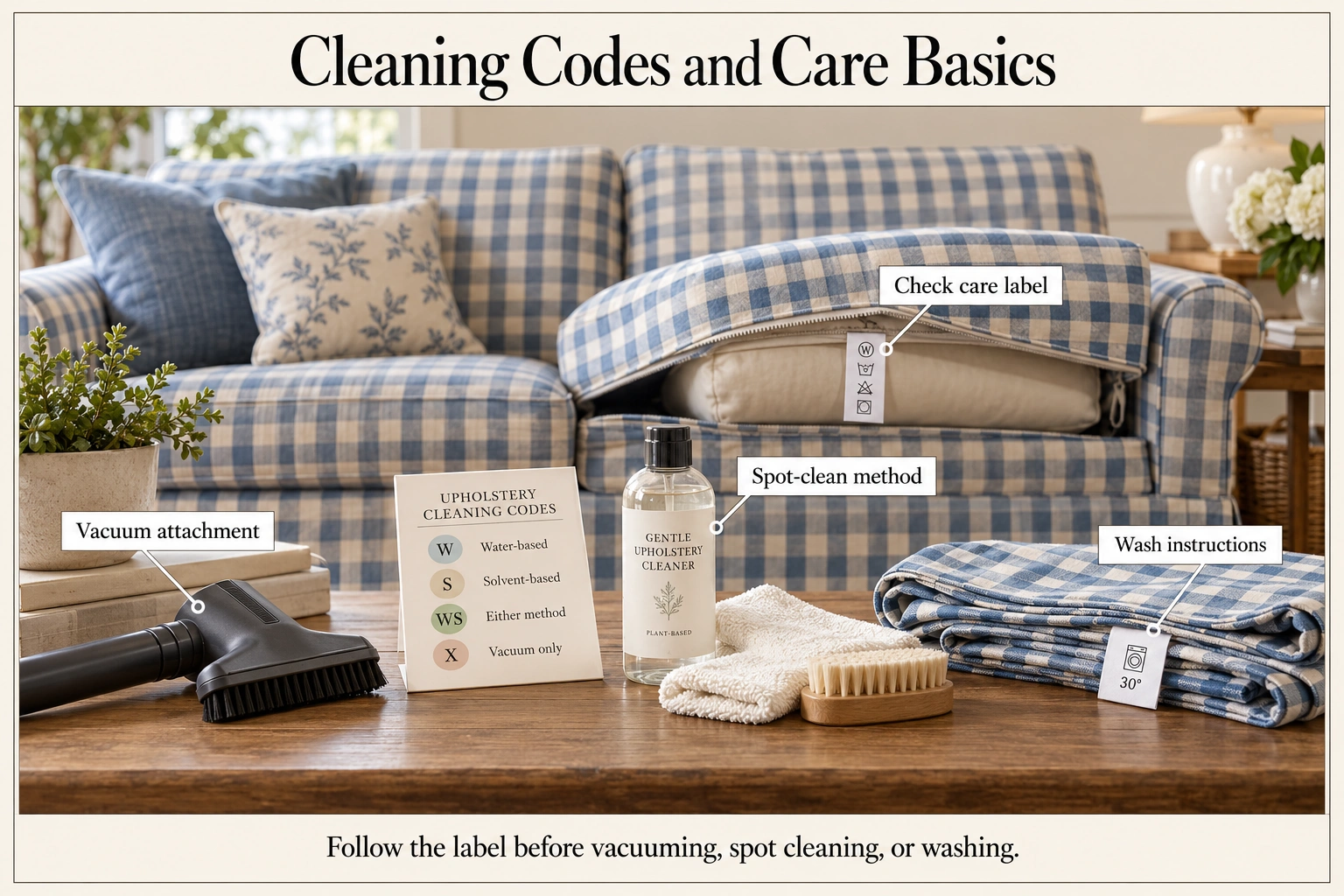
Care depends on the specific fabric and furniture instructions. The checked pattern doesn’t establish whether water, solvent cleaners, or machine washing are appropriate. Find the care label before treating a spill, and keep cover-washing instructions separate from instructions for fixed upholstery.
Common cleaning-code meanings include:
| Code | General meaning |
| W | Specified water-based upholstery cleaners |
| S | Specified solvent-based cleaning |
| WS or SW | Appropriate water-based or solvent-based spot cleaning |
| X | Vacuuming or light brushing; no water or solvent cleaner |
These codes guide cleaning-method selection, but the complete manufacturer instructions still govern the process. Ashley’s published guidance also includes restrictions on saturation and cushion-cover cleaning.
Use the recommended upholstery attachment for routine vacuuming. Rotate cushions only when their design allows it, and follow the stated procedure for spills.
For washable slipcovers, check temperature, drying method, and refitting instructions before removal. Don’t assume that a zipper means the cover belongs in a washing machine. Seek professional advice when the label is missing or the permitted treatment is unclear.
Frequently Asked Questions
Can a Gingham Couch Work in a Small Living Room?
Yes. Its suitability depends on the furniture’s dimensions and the room’s overall arrangement. A compact sofa or loveseat can leave space for movement, while quieter surrounding textiles can balance the checks. Evaluate pattern contrast as well as check size; small checks aren’t automatically the least noticeable option.
Does Gingham Upholstery Hide Stains?
Checks may make some marks less noticeable, but that doesn’t make the fabric stain-resistant or easier to clean. Visibility depends on the colors and the mark itself. Base practical decisions on the fabric’s documented properties and care instructions, especially when the pattern includes white or cream areas.
Can You Machine-Wash a Removable Gingham Couch Cover?
Only when the manufacturer explicitly permits it. Removable covers may require spot cleaning or another specified method. Check the instructions for the exact cover, including washing temperature and drying restrictions. Removability describes how the cover comes off; it doesn’t establish how the fabric should be cleaned.
Choosing a Gingham Couch You Can Live With
Choose the checks alongside the room, then confirm that the seating fits, feels comfortable, and has manageable care requirements. Compare new furniture with covers and reupholstery before committing. Once the practical decisions are settled, use surrounding colors, textures, and patterns to make the sofa feel at home.
Disclaimer
This content is for general informational purposes only. Homes, needs, preferences, budgets, and circumstances vary. Seek qualified advice for safety concerns, installation, repairs, legal matters, structural work, electrical systems, plumbing, HVAC, or major property decisions, and follow product-specific instructions.