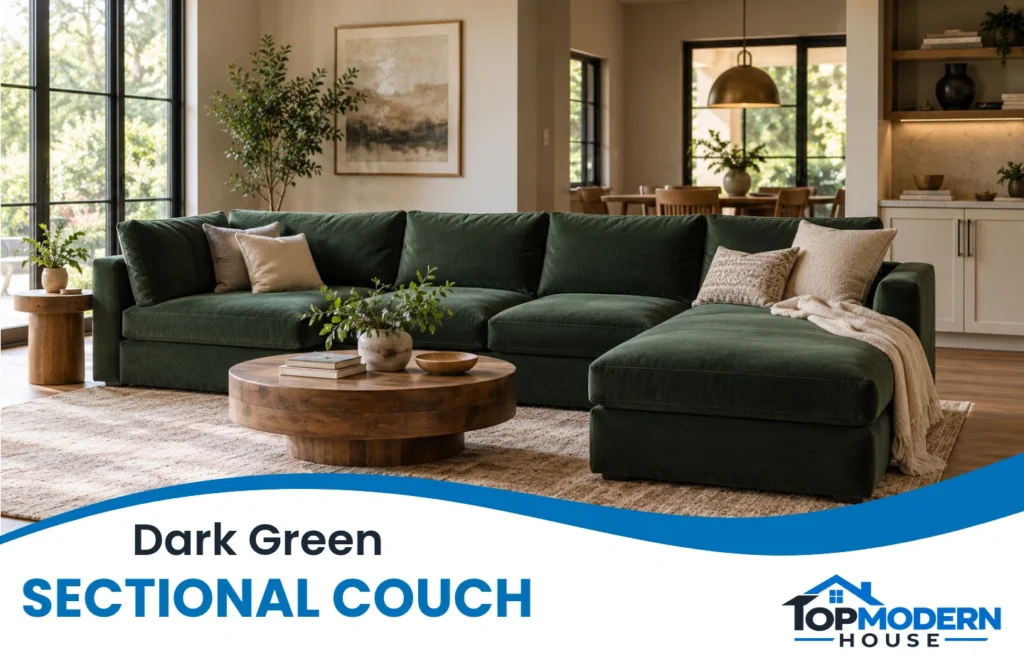
A dark green sectional couch can look right in a product photo and still be wrong for your living room. The chaise might interrupt a walkway, the cushions may feel too deep, or the green could look different beside your flooring.
Start with the room’s usable space and your seating needs. Then compare configurations, test upholstery samples, and check comfort, care requirements, and the complete purchase cost. This order helps you choose a couch you’ll enjoy using as much as looking at.
Short Definition
A dark green sectional couch is upholstered seating made of connected sections, often arranged with a chaise or corner. It combines seating and lounging space with a deep green color.
Topmodrenhouse Mission Statement
Topmodrenhouse helps homeowners and renters make informed, practical choices for comfortable, welcoming homes that reflect their style.
Before You Buy: Quick Checklist
- Measure the full footprint and test walking routes.
- Confirm chaise orientation using the seller’s diagram.
- Compare fabric samples in daylight and evening lighting.
- Check seat depth, support, and everyday comfort.
- Verify cleaning instructions and cover washability.
- Measure delivery access, including doorways and tight turns.
- Compare included pieces, total cost, return terms, and warranty.
What Size and Shape Will Work in Your Room?
The right sectional fits your available floor space while leaving usable routes between doorways, seating, and nearby furniture. Measure its full width and depth, including the chaise or corner return. Choose the configuration around how people move through the room and how many people regularly sit together.
Measure the Footprint and Test the Layout
Record the room’s dimensions, then mark doorways, windows, floor vents, and furniture you’re keeping. Include space for cabinet doors and drawers to open.
Use removable tape suitable for your flooring to mark the sectional’s outside edges. Add the coffee table or ottoman, then walk through the arrangement.
Imagine a chaise extending toward the kitchen entrance. It might fit within the room’s measurements but force everyone to take a detour. A smaller configuration—or a chaise on the other side—could work better.
Check the furniture’s overall dimensions rather than relying on labels such as “apartment size.” Also examine usable seating: wide arms take up floor space without adding room for another person.
Compare Chaise, Corner, and Modular Sectionals
| Configuration | Useful for | What to check |
| Sofa with chaise | Stretching out while keeping a relatively simple layout | Whether the chaise blocks movement |
| Corner sectional | Seating along two adjoining sides of a room | Whether the corner seat suits your seating needs |
| U-shaped sectional | Households wanting seating on several sides | The full footprint and routes around both ends |
| Modular sectional | Adapting a layout or separating compatible pieces | Connectors, finished sides, and permitted arrangements |
A chaise provides lounging space, but consider how it works when everyone wants to sit upright. Compare actual usable seats rather than assuming a larger footprint means more practical seating.
For a dark green modular sectional, ask which pieces can move independently. “Modular” doesn’t automatically mean every arrangement is possible.
Confirm Left- or Right-Facing Orientation
Facing terminology can cause expensive ordering mistakes. Crate & Barrel defines right-arm-facing and left-arm-facing from the perspective of someone looking at the furniture. Confirm the exact configuration against your seller’s labeled diagram before purchasing.
Save that diagram alongside your room sketch. Don’t rely on a lifestyle photograph that might show another variation.
A reversible chaise can be useful, especially for renters, but check how reversal works and whether it applies to the model you’re ordering.
Find the Right Dark Green Shade
Forest, emerald, and olive are useful search terms, but they aren’t precise color specifications. Two retailers may use the same shade name for noticeably different fabrics.
An olive green sectional couch may suit an earthy palette, while an emerald option may provide stronger contrast. Treat those descriptions as starting points and make the decision using the actual upholstery.
Order fabric swatches where available and compare them:
- Beside your flooring and largest existing furniture pieces.
- Against the wall behind the proposed couch.
- In daylight and under your usual evening lamps.
- From different viewing angles, especially with textured or lustrous fabrics.
Keep the sample in the room long enough to see whether you consistently like it. A small swatch helps assess color and texture, although it can’t fully reproduce the appearance of an entire sectional.
Customer photos offer additional context, but lighting and camera settings affect them too. Trace inspiration images back to an identifiable product rather than assuming every pictured couch is available to buy.
Choose Upholstery That Suits Your Household
Choose fabric by its feel, care requirements, and suitability for your routine. The color alone won’t tell you whether upholstery will handle your household well.
For a home with children, consider how you’ll deal with spills. With pets, think about visible hair, claws, and access to replacement covers. Ask for details about the exact upholstery instead of relying solely on a “family-friendly” description.
Compare Velvet, Chenille, Corduroy, and Woven Fabrics
These terms describe different textile characteristics, not a simple quality ranking.
| Upholstery option | What to assess before buying |
| Velvet | Surface appearance from different angles, feel, and approved cleaning methods |
| Chenille | Texture, yarn construction, and care requirements |
| Corduroy | Rib size, tactile feel, and how you’ll remove debris from the texture |
| Other woven fabrics | Fiber content, weave, surface texture, and maintenance instructions |
“Woven” is a broad category, while labels such as “linen-look” describe appearance without necessarily identifying fiber content. Read the composition separately.
For performance fabric, ask what the manufacturer specifically claims and how it instructs you to clean the material. The label doesn’t establish that a fabric is waterproof, scratchproof, or suitable for every cleaning product.
Check Cleaning Instructions and Cover Washability
Removable covers aren’t automatically machine washable. A zipper may allow a cover to be fitted or replaced without permitting home laundering.
Before ordering, confirm whether covers can be washed, spot-cleaned, or professionally cleaned, and follow the specified method. Check whether the seat and back cushions have different instructions.
Avoid choosing a fabric that requires more maintenance than you’re willing to provide. A couch that fits your cleaning routine is usually a more comfortable purchase than one you’re afraid to use.
Check Comfort Beyond Looks
Overall depth measures the furniture’s footprint; usable seat depth describes the space available for sitting. Both matter, but they answer different questions.
Compare the proposed sectional with a sofa or chair you already find comfortable. Measure that seat and note whether you prefer sitting upright, curling up, or stretching out.
During a showroom visit, try your normal positions rather than briefly sitting on the front edge. Check whether:
- Your feet rest comfortably when you sit back.
- The back cushions provide support where you want it.
- The seat feels comfortable when you stand up again.
- The chaise accommodates your preferred lounging position.
- Other household members find it comfortable too.
Deep seating may appeal to someone who curls up, while another person may need extra cushions to sit upright. Cushion softness is also personal; product descriptions such as “plush” don’t replace a sit-test.
Ask about cushion fill, routine fluffing, and whether cushions can be rotated or reversed. For online-only purchases, give extra attention to dimensions and return terms.
What Colors Go With a Dark Green Sectional?
Cream, warm white, beige, tan, and wood tones are useful starting points for a dark green sectional. Rust, muted pink, mustard, or blue can provide accents. The best combination depends on the upholstery’s undertone, your existing finishes, and whether you want a quiet room or stronger contrast.
Start with what you’re keeping. A large rug, wood floor, or stone fireplace already influences the palette.
Try one of these approaches:
- Soft contrast: Cream cushions, a light neutral rug, and wood furniture.
- Earthy color: Oatmeal textiles, tan accents, and small touches of rust.
- Cooler contrast: Off-white, blue accents, and restrained black details.
These are options to test, not fixed formulas. Place samples together before buying accessories.
You also don’t need to match every green exactly. A patterned cushion or artwork containing a related shade can connect the couch with the room without making everything identical.
For a large dark green sectional sofa, assess the balance of the whole space. Lighter surrounding surfaces can create contrast, while a darker palette may suit someone who prefers an enclosed, cozy atmosphere.
Compare the Complete Purchase Cost
Compare the exact sectional you intend to order. The lowest displayed price may refer to a smaller configuration, another upholstery option, or an individual component.
A useful comparison includes dimensions, fabric, cushion construction, included pieces, delivery, and return conditions. This makes differences in price easier to understand.
Check What the Listed Price Includes
Build a short comparison for each shortlisted option:
- Number and type of modules.
- Selected upholstery and any upgrade charge.
- Included ottoman, pillows, or other accessories.
- Delivery, room placement, and assembly services.
- Applicable taxes and optional purchases.
Retail listings can contain both complete sectionals and individual modules, so confirm the purchase unit before comparing prices.
A simpler stationary model may be enough when you don’t need reclining seats, storage, or a sleeper. Pay for features you expect to use.
Where construction information is provided, compare frame materials, cushion details, and support systems. A higher price alone doesn’t explain how the couch is built.
Review Returns, Warranty, and Replacement Options
Read the terms for your selected configuration, particularly when ordering custom upholstery.
Check the return window, collection or shipping charges, possible restocking fees, and any exclusions for customized items. Ask what happens if the furniture cannot pass through your delivery route.
Review what the warranty covers rather than judging it only by its duration. Ask whether replacement covers, cushions, or individual modules are currently available, while recognizing that future availability may change.
Verify Delivery Access Before Ordering
A sectional can fit the living room and still fail to reach it. Check the delivery dimensions of each piece against the narrowest openings and tightest turns along the route.
Measure doors, hallways, stair landings, and elevators. Ask whether the delivery measurements include packaging and whether legs or other parts are removed during delivery. Crate & Barrel specifically advises checking sectional pieces against doorways, stairs, and hallways.
For an apartment, confirm building delivery arrangements and elevator access in advance. Send measurements and photographs to the delivery provider when a turn or landing looks difficult.
Also clarify the service level. Curbside delivery, placement inside the home, and full assembly are different services. Follow the manufacturer’s assembly instructions and confirm who will connect the sectional pieces.
Frequently Asked Questions
Can a Dark Green Sectional Work in a Small Living Room?
Yes, provided its footprint suits the room and leaves practical walking routes. Color alone doesn’t determine whether a sectional works in a small space. Compare arm width, overall depth, chaise length, and nearby furniture, then test the layout before committing. Lighter surroundings are one optional way to introduce contrast.
How Can I Avoid Regretting a Green Couch?
Choose a shade you enjoy beside the finishes you already own, rather than buying mainly because it appears in trend images. Live with fabric samples before ordering and check them under your normal lighting. Give comfort, cleaning requirements, and room fit equal weight; those affect satisfaction long after the purchase.
What Makes a Green Sectional the Best Choice for My Home?
The best choice meets your room measurements, seating preferences, maintenance needs, and budget without requiring uncomfortable compromises. One household may value washable covers, while another prioritizes supportive upright seating or a reversible chaise. Define your non-negotiables first, then compare suitable models instead of looking for a universal winner.
Make Your Final Choice
Before ordering a dark green sectional couch, confirm the layout, chaise direction, fabric sample, sitting comfort, cleaning requirements, delivery route, and complete price.
Resolve any uncertainty that could change the purchase. A green you enjoy, a layout that works, and care requirements you can manage are stronger reasons to buy than an appealing product photo alone.
Disclaimer
This content is for general informational purposes only. Homes, needs, preferences, budgets, and circumstances vary. Follow manufacturer instructions and seek qualified professional advice for safety, installation, repair, structural, electrical, plumbing, HVAC, legal, or major property decisions.